Building Aspen around connected ideas
On this page
I built Aspen Research from scratch as a Roam-style notebook inside this website: a private space for research, with selected notes published to the garden. I wanted to follow references and return to my writing without losing my place.
A note may begin with a passage in a book and later become useful in a different argument. Sönke Ahrens describes a collection built around that possibility in How to Take Smart Notes. For Aspen, the question is how to preserve the original context while making those other connections possible.
Writing out the thought
Ahrens distinguishes a reminder from a thought that has been written out. A few words may be enough to bring something back during a reading session. Months later, I may need the explanation those words once stood for.
In Daily notes, an unfinished observation can sit beside the passage or question that prompted it. The date records the encounter. Writing out the idea makes it useful after I’ve forgotten the reading session.
In my notes on the book, Use your own words to check understanding develops one of Ahrens's points about reading. Familiar wording can make an argument feel understood. Trying to explain it can reveal a missing step. A smooth explanation can still be inaccurate, so it needs to be checked against the passage.
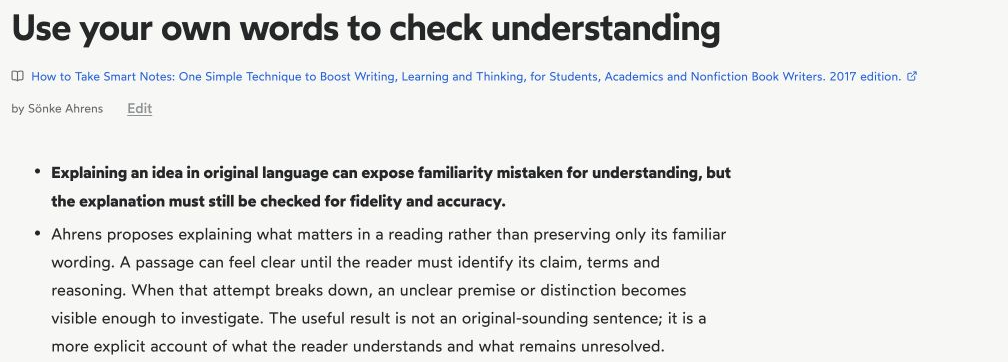
One note can take part in several discussions
Aspen's editor starts with bullets that can be nested and expanded. That makes it easy to keep a question beside its supporting detail. I can focus on one branch while the rest of the page stays out of the way.
An outline also puts a thought in a particular place. A note about checking understanding might begin under today's reading, but later belong in a discussion about explaining software. Copying it into each discussion would leave me with several versions to maintain. A reference lets me reach the same note from each place.
Ahrens describes a similar distinction in Niklas Luhmann's slip box, or Zettelkasten. A card had a stable address, and references let it take part in discussions beyond its immediate neighbors. Its position did not have to determine every future use. The collection could grow as one thought prompted an addition or an objection.
What the connection actually says
The note on understanding connects to Retrieve before checking. Attempting an explanation before looking at the answer exposes what I can recall. Comparing that attempt with the source helps me check whether I understood it accurately. Recall and understanding are related here, but they are different things to examine.
Its connection to Writing is part of thinking does a different job. The effort of putting an explanation into words can clarify or change the idea. One reference concerns what I can bring back from memory. The other concerns what happens as I formulate the thought.
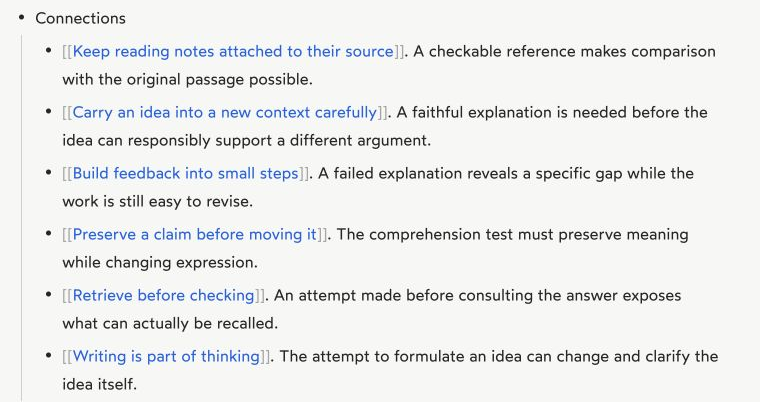
Bidirectional links let me see the connecting passage from either note. Split view keeps both explanations visible while I compare them.
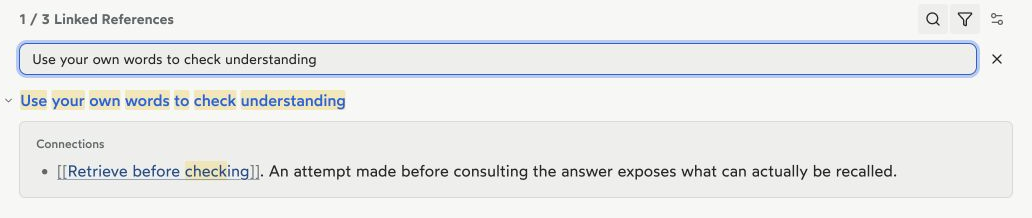
Organization can change with the question
The overview Thinking with connected notes offers a few routes through my reading notes. One follows a thought from its first capture to a developed explanation. Another brings together notes about checking understanding. A third concerns choosing an argument for a reader.
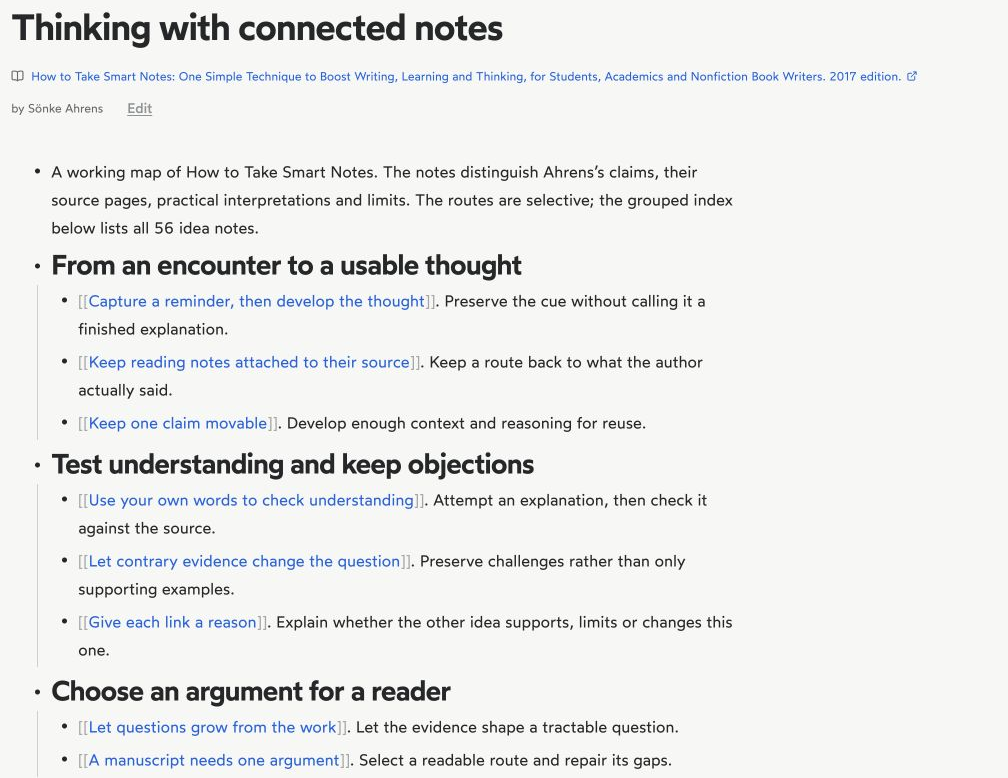
The overview is an ordinary page. I can reorganize it around a different question without moving or duplicating the underlying notes.
Ahrens suggests organizing around where a thought may be useful again. A note made while reading his book might later belong in an article about learning. The source and date remain available, but they no longer determine the only route to it.
Ahrens also describes questions developing through the notes. In this example, How do I remember what I read? leads to a more specific problem: How can I tell whether my explanation is accurate? That changes which notes matter. I may need something about evidence or a counterexample, alongside the notes about recall.
Writing for someone else
My private research can hold several possible directions, unfinished explanations, and objections I have not resolved. A public article chooses one question and gives a reader enough context to follow it.
Ahrens describes the work involved in moving from the slip box to a manuscript. Ordering notes can reveal a missing definition, a repeated point, or an unsupported conclusion. Writing the transitions tests whether the argument holds together.